
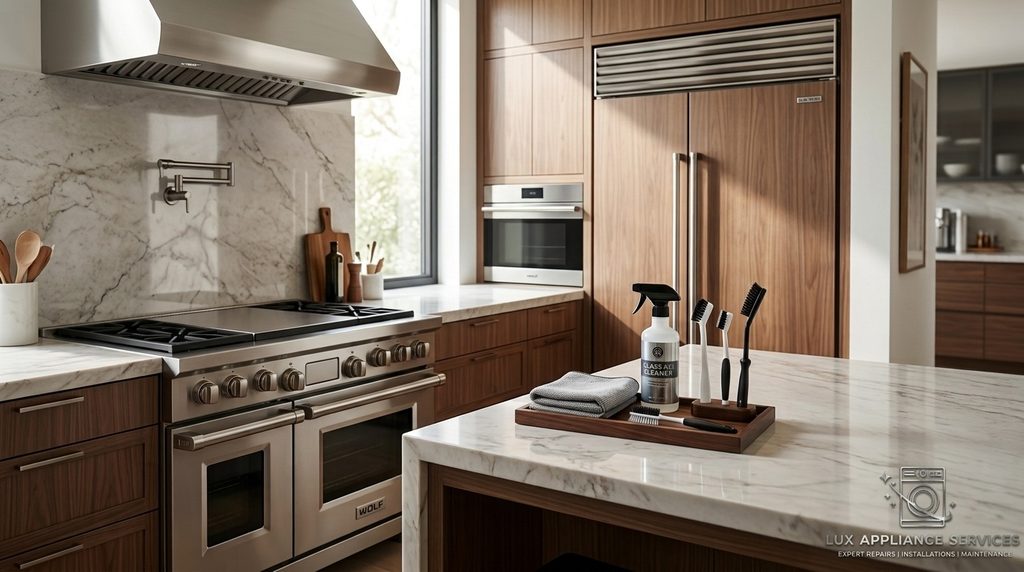
A built-in Sub-Zero refrigerator can look immaculate while dust is building around its condenser. A Wolf range can still light normally while grease collects around burners and ventilation filters. And an ice maker can keep producing clear-looking cubes while mineral deposits accumulate inside the water system.
That is why a luxury appliance maintenance schedule should focus on individual components, not just occasional deep cleaning. Manufacturer guidance varies by appliance and model, so the safest approach is to combine routine homeowner care with the intervals specified in your owner’s manual.
For North Texas homeowners, water quality is another consideration. The North Texas Municipal Water District describes its treated water as moderately hard and notes that mineral deposits can leave spots on dishes and limescale on plumbing fixtures.
What Is a Luxury Appliance Maintenance Schedule?
A useful schedule separates appliance care into four levels: after-use cleaning, monthly or frequent checks, periodic maintenance, and professional inspection.
The right interval is not always the same across brands. Sub-Zero, for example, currently gives a general condenser-cleaning recommendation of every three to six months, while several model-specific care guides state six to twelve months.
That difference is important. A general internet checklist should never override the instructions for your exact model.
Luxury appliance maintenance schedule at a glance
| Appliance or component | Recommended timing | What to address |
|---|---|---|
| Sub-Zero condenser | Every 3–6 months generally; some model guides say 6–12 months | Dust and lint around condenser |
| Sub-Zero water filter | Every 6 months or when indicated | Replace filter according to model |
| Sub-Zero undercounter ice maker | Every 6 months | Clean and sanitize water-contact surfaces |
| Sub-Zero Designer undercounter ice maker | About every 3–6 months | Adjust interval for water hardness |
| Thermador dishwasher filter | Every 1–4 months, depending on use | Remove food soil and buildup |
| Miele dishwasher filter | Every 30–60 program sequences | Clean filter combination when indicated |
| Thermador hood metal grease filter | Every 1–3 months | Wash grease filters |
| Thermador recirculating carbon filter | Usually every 4–6 months | Replace when dirty or discolored |
| Miele hood grease filter | Every 3–4 weeks | Wash reusable grease filter |
| Outdoor grill | After each use; deeper care at least annually | Grates, drip areas and exterior |
Manufacturer guidance should take priority where it differs from this table.
What to Clean on High-End Kitchen Appliances and When
The most effective routine is not about cleaning everything every Saturday. It is about cleaning the components that collect food, grease, dust, water minerals, and moisture at the interval appropriate for that component.
Refrigerators and freezers
Built-in refrigeration deserves priority because it operates continuously. On Sub-Zero models, condenser care is particularly important, but the correct interval depends on the model. Sub-Zero’s general maintenance guidance says every three to six months, while specific model documentation can state six to twelve months.
The inside should be cleaned with the method approved for the model, and door gaskets should be kept free of food residue. Sub-Zero specifically recommends mild detergent and water for refrigerator interiors and warns against steam cleaning and certain cleaners, including vinegar or alcohol-based products on interior surfaces.
Water filtration also belongs on the calendar. Sub-Zero documentation for applicable filtration systems recommends replacement every six months, or sooner when the appliance indicates a change is needed.
For homes using moderately hard water, mineral buildup deserves closer attention around water-connected appliances. The NTMWD notes that hardness can leave limescale and spotting as water evaporates.
Sub-Zero Wolf maintenance checklist for refrigeration and cooking
There is no single universal Sub-Zero Wolf checklist because the brands cover several different appliance types. A more useful approach is to separate refrigeration, cooking, ventilation, and outdoor equipment.
For Sub-Zero refrigeration, the checklist should include the condenser, door seals, interior surfaces, water filtration where fitted, and ice-making components. For Wolf cooking appliances, the focus shifts to burner areas, grates, oven surfaces, racks, and ventilation.
Wolf’s official cleaning guidance recommends model-appropriate care for burner grates and explicitly says not to put its burner grates in the dishwasher or leave them in a self-cleaning oven.
The important point is that Wolf does not publish one blanket monthly schedule for every component. Cleaning should be based on the part, cooking habits, visible buildup, and the specific Use and Care Guide.
Ovens and ranges
For a Wolf, Viking, or Thermador oven, clean visible spills and food residue before buildup becomes heavy. Oven interiors, racks, door glass, seals, burner areas, and control surfaces all require different care depending on their materials.
Thermador allows self-cleaning on compatible ovens, but its guidance says to follow the owner’s manual for activating the cycle and to remove accessories that are not approved for self-cleaning.
Miele similarly offers Self Clean on applicable ovens. Its guidance emphasizes removing coarse soil first because heavy residue can produce smoke during the cycle.
In other words, there is no responsible universal rule such as “run self-clean every three months” for every luxury oven. Use the manufacturer’s instructions and the actual condition of the cavity.
Dishwashers
Dishwashers can accumulate food particles, detergent residue, and mineral deposits even when the tub appears clean.
Thermador recommends cleaning the dishwasher filter every one to four months depending on usage, and it specifically notes that limescale can block spray-arm nozzles.
Miele takes a different approach. Its dishwashers can display a filter-cleaning reminder after 50 program sequences by default, with the interval adjustable between 30 and 60 sequences depending on the model.
This is a good example of why appliance maintenance should be model-specific. A homeowner using a Miele dishwasher several times a week should track cycles rather than simply copying a monthly calendar reminder from another appliance brand.
Vent hood maintenance: the filter schedule matters
The underside of a premium vent hood is exposed to grease, steam, and cooking residue every time you use the range. The filter therefore deserves a more frequent schedule than many homeowners expect.
Thermador recommends cleaning metal grease filters every one to three months, depending on usage. For recirculating hoods, activated charcoal filters generally need replacement every four to six months depending on use.
Miele recommends cleaning reusable hood grease filters every three to four weeks and notes that grease can harden if filters go several months without cleaning.
Viking also recommends cleaning dishwasher-safe baffle and mesh filters at least monthly, with more frequent cleaning for homeowners who fry, grill, or wok cook frequently. Its recirculating charcoal filters are generally replaced every six to twelve months depending on cooking habits.
The practical lesson is simple: the heavier the cooking load, the shorter the filter interval should be.
Ice makers need their own calendar
Ice makers are often overlooked because homeowners think of them as part of the refrigerator rather than as a separate water-handling system.
Sub-Zero recommends cleaning and sanitizing surfaces that contact the water system of applicable undercounter ice makers every six months. Its guidance also notes that poor water quality may require more frequent cleaning.
For the newer Designer undercounter ice maker, Sub-Zero recommends approximately every three to six months depending on water hardness, with a shorter interval when ice quality changes or the water supply contributes to more scale.
That is particularly relevant for homeowners in North Texas who receive moderately hard water through an NTMWD supply. It does not mean every home needs a three-month ice-maker schedule, but it is a reason to watch for scale, changes in ice quality, and a shorter-than-expected cleaning interval.
Outdoor grills from Lynx, Coyote and Blaze
Luxury outdoor appliances should not be treated as seasonal decorations. They collect grease, food residue, ash, and moisture just like indoor cooking equipment.
Coyote recommends cleaning grill grates after each use and performing deeper cleaning and maintenance around the beginning and end of the grilling season, with each component cleaned at least annually.
Blaze documentation likewise calls for cleaning the grill after each use and emphasizes allowing components to cool before cleaning.
For homes with frequently used outdoor kitchens, make the grate and drip-area cleanup part of the normal cooking routine. Any work involving gas connections, fuel lines, electrical components, or internal ventilation should be left to a qualified professional rather than handled as a casual DIY task.
How North Texas conditions can change your schedule
A maintenance calendar should reflect the environment around the appliance, not just the date on the calendar.
North Texas experiences substantial summer heat. Dallas/Fort Worth normal high temperatures reach about 95.6°F in July and 95.8°F in August based on the National Weather Service’s 1991–2020 climate normals.
That does not create a different manufacturer interval by itself, but it is a practical reason to be attentive to refrigeration airflow, especially in high-use kitchens and built-in installations. A heavily used outdoor grill or vent hood may also accumulate residue faster simply because it is used more often.
Water quality can matter just as much. Where a home receives moderately hard NTMWD water, mineral buildup may be more noticeable around dishwashers, ice makers, and other water-connected components.
For homeowners in Grapevine, Southlake, Westlake, or nearby Dallas communities, the right schedule should therefore combine manufacturer guidance with actual household usage.
Signs It’s Time for Professional Appliance Care
A calendar is useful, but appliances can tell you when attention is needed before the next scheduled date.
Watch for:
- A refrigerator running noticeably more often or showing temperature drift
- Slower or reduced ice production
- Visible scale around water-connected components
- Dishwasher spray arms with blocked openings or recurring residue
- A hood with weaker airflow or visibly loaded grease filters
- Burners with uneven flames, delayed ignition, or persistent residue
- An oven that is taking noticeably longer to preheat
- New rattling, unusual noise, excessive heat, odors, or moisture
These signs do not automatically identify the cause. They indicate that waiting for the next routine cleaning may not be appropriate.
DIY vs. Professional Appliance Care
Homeowners can safely handle many visible cleaning tasks when the manufacturer permits them: wiping approved surfaces, cleaning accessible filters, removing food residue, and following the appliance’s documented cleaning cycle.
The line is crossed when the task involves gas components, electrical connections, internal wiring, sealed refrigeration systems, inaccessible components, ductwork, or unexplained performance problems.
With a built-in luxury appliance, there is also less room for improvisation. A cleaning product that works on one stainless-steel surface may be unsuitable for another, and a procedure that applies to one Sub-Zero or Miele model may not apply to the next. Manufacturer instructions should always take priority over generic appliance-cleaning advice.
Build a Schedule Around the Whole Kitchen
A high-end kitchen rarely contains one premium appliance. A typical setup may include a built-in refrigerator, dishwasher, wall oven, range, hood, ice maker, wine storage, and outdoor grill.
Rather than keeping separate reminders for every appliance, group tasks by frequency. Handle after-use cleaning with the normal kitchen routine, place filters and ice-maker care on recurring reminders, and use a seasonal or annual professional inspection to review the equipment as a whole.
That approach is especially useful for a multi-appliance home in areas such as University Park, Preston Hollow, Uptown, or Southlake, where several built-in systems may operate together every day.
Conclusion: Protect Your Investment With a Smarter Maintenance Schedule
A luxury kitchen deserves more than a once-a-year wipe-down. The right luxury appliance maintenance schedule keeps track of the components that matter most: refrigeration condensers, filters, ice-making systems, dishwasher filters, oven surfaces, burner areas, and vent hood filtration.
The biggest mistake is assuming every premium appliance follows the same calendar. Sub-Zero, Wolf, Miele, Thermador, Viking, Lynx, Coyote, and Blaze all publish guidance that varies by appliance and model, so your owner’s manual should remain the final authority.
For homeowners in Grapevine and throughout Dallas, Southlake, Westlake, University Park, Preston Hollow, and Uptown, Lux Appliance Services LLC can create a customized appliance care plan around your home’s equipment and usage.